Sign in
 Sign up






Dubai's property market is heading for equilibrium rather than a downturn, according to the man who built much of its skyline. Speaking at the AIM Congress, held on 7–9 September at the Dubai World Trade Centre with more than 15,800 participants from 181 countries, Emaar founder Mohamed Alabbar said a large volume of new supply arriving by 2027 will settle the market. "A lot of supply is coming in, so I think there'll be a nice balance in the city," he said. Prices, in his view, may move 5 to 10 per cent in the process.
An adjustment, not a crisis
Alabbar framed the softening in plain terms. "I would say that an adjustment of 5 per cent to 10 per cent because it's an extraordinary situation," he said, pointing to the regional conflict that disrupted the first half of the year. His conclusion was deliberately unalarmed: "I don't look at it as a crisis. I think it's adjustment time." The booking data he cited tracks that arc closely — Emaar recorded 700 cancellations in November 2025 against 2,500 sales a month, saw cancellations climb to 1,100 when the conflict began in the spring, then fall back to 150 once a ceasefire held.
Discounting is splitting the field
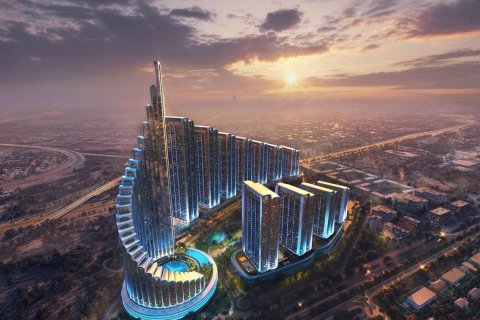
The clearest dividing line between developers right now is price. "Right now, we have developers who are giving 50 per cent discount, 20 per cent discount," Alabbar said, before setting out Emaar's own position: "Our policy: we sell good product. We don't give discounts." The company can hold that line because of strong cash flow and low debt, with roughly 90,000 units in production across 18 markets and a Dh200 billion megaproject launched in June — more than 4.5 million square metres designed for around 150,000 residents.
The August numbers behind the forecast
Recent data explains why the question of balance is being asked at all. Dubai recorded Dh27.89 billion in property sales across roughly 11,600 transactions in August, with off-plan accounting for about 75 per cent of residential deals. Transaction volumes were down 37 per cent year on year, and the average residential price eased to Dh1,636 per square foot — a 1.7 per cent annual decline, the first since February 2021. "The market is entering a more mature cycle," said Ronan Arthur, director of residential valuation at Cavendish Maxwell, adding that the fundamentals supporting demand remain intact.
For buyers, a market in adjustment is a market with room to negotiate: more finished stock, longer decision windows and developers competing on terms. It also makes the choice of developer matter more than it did during the boom — cash position, delivery record and escrow discipline separate those who can hold their pricing from those already cutting it.